
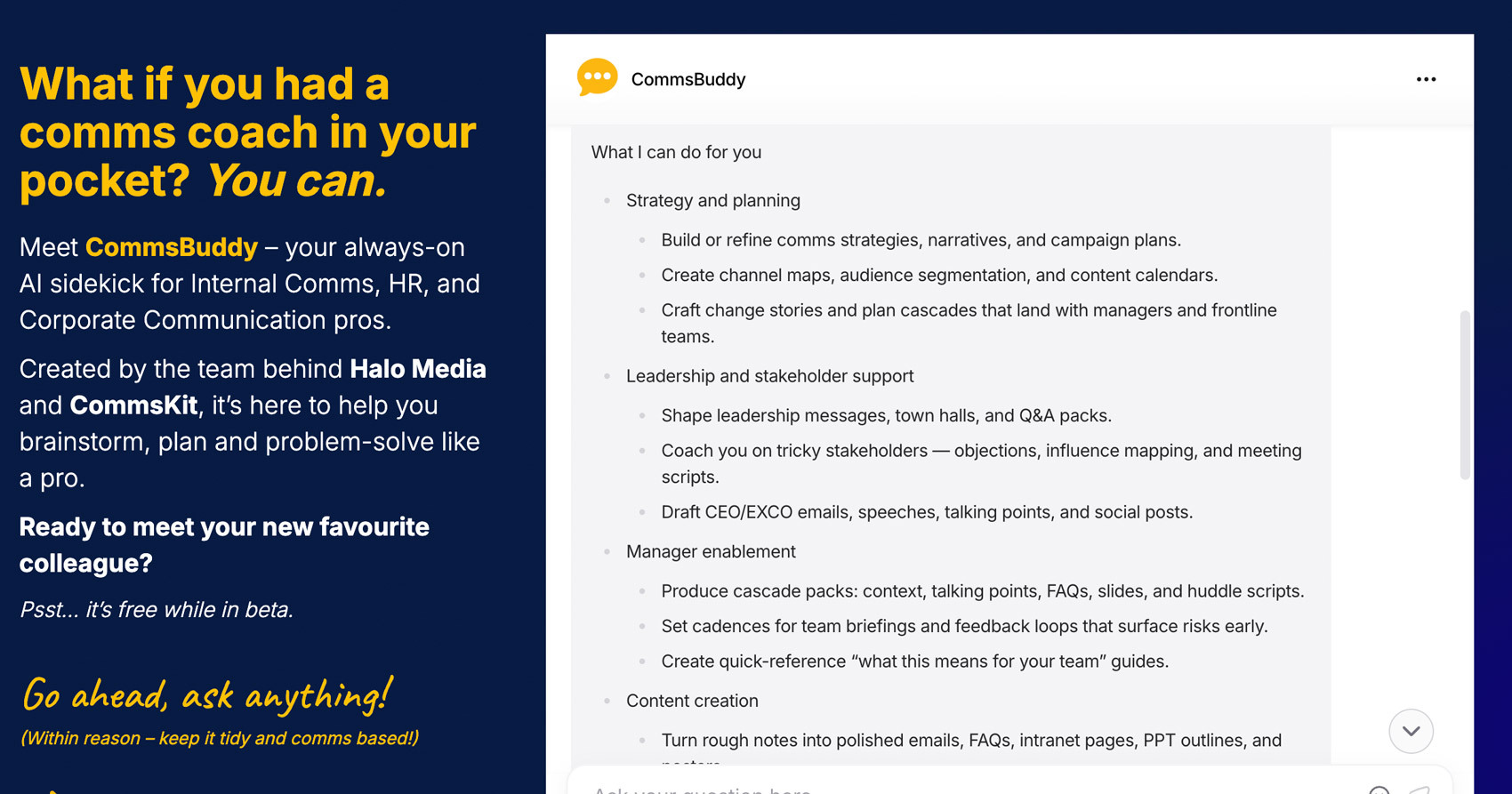
Editor’s Note: Most AI tools treat internal communications like any other writing task—give it a prompt, get generic output, hope for the best. CommsBuddy takes a different approach: it's built specifically for comms professionals, trained on the frameworks, playbooks, and strategic thinking that actually drive the discipline.
We spoke with CommsBuddy's founder Louise Cunningham about why the industry needed a dedicated AI assistant, how it's being used as a strategic thinking partner rather than just a content generator, and what's next as they expand from a free tool for practitioners into CommsKit, a full communications suite launching in 2026.
What was the "lightbulb moment" that made you realize internal comms professionals needed their own dedicated AI assistant?
Whether I’ve been part of a big comms team or in a team of one, my biggest challenge has usually been showing how all of the day-to-day activities I’ve been working on (or asked to work on) contribute to the bigger goals.
The lightbulb moment was realising people knew far less about AI than I expected. I’ve spent nearly two years deep in it, so it felt natural to me – but when I spoke at a major industry conference, it was clear that even brilliant comms pros were struggling with the basics. Prompting, framing, knowing what to ask – all the things AI needs to work properly.
It hit me that if someone isn’t a strong prompter, they won’t get the value, no matter how good the tool is. So instead of expecting comms teams to learn advanced prompting, the smarter solution is to give them an AI already trained on comms.
That’s how CommsBuddy started—built on real comms frameworks and best practice, and far more useful than asking a generic model to guess its way through communication work.
What makes it different from consumer AI tools like ChatGPT or Microsoft Copilot?
CommsBuddy is trained entirely on communications knowledge—frameworks, playbooks, best practices, and practitioner insight, all aggregated and anonymised so it reflects established comms thinking rather than one person’s view.
Where general AI tools depend on how well you phrase a question, CommsBuddy already understands the context. You don’t need perfect prompts or jargon. And unlike Copilot, which sits inside Microsoft, or ChatGPT, which searches generically, CommsBuddy searches with comms-specific intent.
What's been the most surprising use case you've seen from early users during the beta phase?
The biggest surprise is how strategic the questions are. People are using it for measurement, behaviour change, and leadership influence – the harder end of comms, not for the trivial stuff.
Because it draws on deeper frameworks in the background, users get structure and clarity without having to build it themselves. It’s become more of a thinking partner than a writing tool – exactly what we wanted.
How should users think about confidentiality when using CommsBuddy, and what guardrails have you built in to protect proprietary company information?
Confidentiality is a major concern, so CommsBuddy is built with strict guardrails. Users can’t upload documents, and the tool collects no personal data – no logins, no profiles, no way to see who asked what. We only see high-level usage trends.
It’s also trained not to surface names or identifiable details, and all analytics are automatically anonymised when we do our reviews. So, the data we work with is broad industry insight, not personal user information.
Your website mentions "it gets smarter every day." How does CommsBuddy's learning work?
CommsBuddy improves through patterns, not personal data. Users can give a thumbs up or down, which helps the model learn what works. It also tracks its own confidence scores – if it’s not confident in its answer, it’s flagged, and we review those gaps in our monthly analysis and train it to improve.
We also watch emerging trends. Early on, lots of questions centred on change communication, so we researched and deepened the knowledge there. Over time, it becomes a reflection of what practitioners need most. It’s learning from industry patterns, not individual-specific information.
Can you give us a teaser of what's coming next? What capabilities are you most excited about?
CommsBuddy is the first module in CommsKit – a new communications suite launching in early 2026. CommsKit came from seeing the same patterns everywhere: comms teams reinventing the wheel, departments working in silos, and large workforces struggling with clarity.
CommsKit covers the core needs of big, distributed teams – engagement, safety, onboarding, internal comms, and access to information – packaged into reusable, structured modules. The suite includes subscription employee engagement campaigns, onboarding, HSE, internal comms systems, a managed intranet, and Loop, our company-specific AI that gives employees easy access to essential information.
It’s built for complex operations like mining, logistics, manufacturing, and energy, with one aim: communication that actually reaches people. It’s a completely unique solution that solves repeated problems we’ve seen over decades.
How do you see CommsBuddy scaling from supporting individual practitioners to potentially serving entire comms teams or departments?
CommsBuddy will stay free for the comms industry. It’s our way of supporting a field that’s under-resourced and overstretched. The free version will remain a shared knowledge tool for strategic thinking, clarity, and quick wins. So it provides support for individuals through to departments.
Alongside it, we’re developing CommsBuddy Pro – a paid, company-specific version trained on an organisation’s own information, tone, and ways of working. It blends CommsBuddy’s collective intelligence with a company’s unique context, which will serve the larger enterprise needs.
What kind of time savings or efficiency gains are beta users seeing?
Because it’s free, the ROI is immediate 😀. It saves time, gives clarity, and helps teams avoid reinventing the wheel.
Most organisations don’t have the time or skills to build their own AI, and IT teams can’t train something rooted in comms expertise. CommsBuddy Pro offers a simpler, scalable option that’s secure and tailored to real-world communication needs.
And because it’s the only comms-specific model trained on aggregated industry patterns – and, importantly, it’s managed and maintained to stay updated – it offers insight no generic tool can match.
How do you position CommsBuddy as augmenting rather than replacing the expertise and creativity of internal comms professionals?
AI isn’t here to replace humans – it’s here to strengthen them. The calculator didn’t replace accountants, and autopilot didn’t replace pilots. A plane can technically fly itself, but you still need a pilot who understands judgment and nuance.
Comms is the same. AI can draft and analyse, but it can’t read a room, sense fear during change, or spot when a message will land badly. Humans bring discernment, taste, and emotional intelligence; AI just helps with the heavy lifting.
For me, AI has expanded what I can do and the speed I can do it. That’s the goal for the industry – not replacement, but growth.
What features or capabilities are at the top of your development roadmap based on early user feedback?
The roadmap is full – the challenge is choosing what to build first! We’re automating CommsBuddy’s analysis so we can share real-time industry insights and quickly spot gaps. Longer term, I’d love it to connect with comms associations so we can see, at scale, what practitioners are struggling with.
Early learnings are shaping CommsLoop, our employee-facing AI, to keep it simple for frontline teams. We’re also creating a CommsHub – a knowledge library built from the questions the industry asks, giving comms pros a shared resource and strengthening general AI tools through collective learning.
CommsBuddy will keep evolving, and the free version’s insights will continue to power the Pro version. We’re only at the beginning, and I’m always open to ideas or collaborations.

Louise Cunningham is a brand strategist and communications specialist focused on helping large, complex workforces communicate clearly. She is the co-founder of Halo Media, where she leads the development of practical, scalable comms systems for industries such as mining, logistics, energy, and manufacturing. Her work blends strategy, design, and technology, with a particular focus on AI-driven tools that make communication easier for frontline and hybrid teams. Originally from South Africa and now based in the UK, Louise works across global operations, drawing on two decades of experience in multilingual, mixed-literacy, and distributed-workforce environments.
You can follow Louise on LinkedIn to learn more.