PERSPECTIVES
In the hit musical Hamilton, Alexander Hamilton, Thomas Jefferson and James Madison hold a closed-door meeting to discuss what would later be known as the Compromise of 1790.
Not in the room? Aaron Burr. In the musical, Burr sings with lament:
I wanna be in the room where it happens 🎵
The room where it happens 🎵
Many internal communicators might sing the same tune. “Having a seat at the table” or being seen as someone who can contribute to discussions about core business topics, such as financial performance, product, talent, and operations, is a frequent topic of discussion for many comms pros.
And, according to one closely watched survey, internal comms pros say they rarely make significant contributions to such discussions. Only 17% of communicators reported contributing a strategic voice on business performance topics in Gallagher’s 2024 State of the Sector survey, and nearly 40% said they only played a supporting role in such discussions.
So, how do you get in the room? And when you’re there, how do you make an impact?
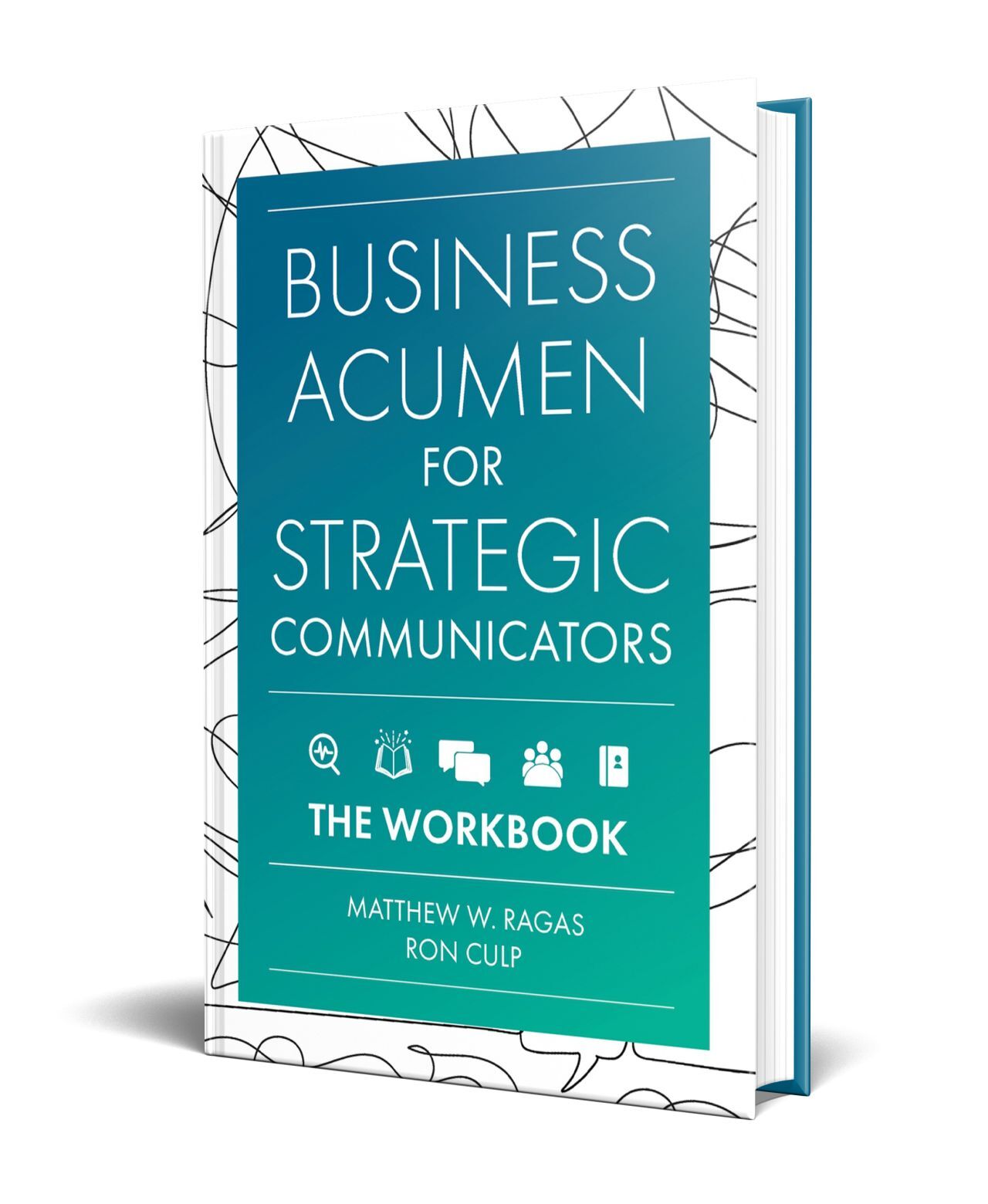
You need to develop business acumen, says Dr. Matt Ragas. Ragas, a tenured professor in the College of Communication at DePaul University, has just published Business Acumen for Strategic Communicators: The Workbook, the latest in a series of publications on the topic with co-author Ron Culp, a comms leader with decades of corporate, agency and government experience.
"To get to the c-suite in a company or a senior level at an agency, you need to be business people with expertise in communication, not the reverse," Ragas says.
Defining business acumen
To be sure, no one is against fostering business acumen in communications professionals, just as much as no one is against “communication.” But Ragas says structuring the topic into something that can be taught, learned and shared requires a common definition as a starting point.
To develop a foundational definition for “business acumen,” Ragas and Culp’s new book details how the duo conducted a structured “Delphi panel” interview process with 25+ senior-level communications professionals from a variety of industries, backgrounds, and experiences. After several rounds, the panel of experts arrived at the following definition:
Business acumen means becoming knowledgeable about business functions, stakeholders and markets that are critical to the success of one’s organization or client; using this understanding to assess business matters through a communications lens; and then providing informed strategic recommendations and actions. As such, professionals should demonstrate a commitment to ongoing learning about a range of business subjects, including interpreting financial statements and information; strategy; operations; supply chain; organizational behavior, culture and structure; marketing and sales; human resources; technology, data and analytics; economics; legal, public policy and regulatory; stakeholder management; and corporate governance and social responsibility.
The definition is striking for both its breadth and depth. One might read the first sentence and assume a cursory understanding of business topics will do. But a look at the second half of the definition suggests communicators have an opportunity to go deep on many topics.
"Business acumen is like learning chess - it's not just knowing how one piece moves on the board,” says Ragas. “Even if you're an expert with that one piece, you need to understand the movements and possibilities of all the different pieces and the overall strategy. You can't really be a counselor and advisor without that."
Business acumen and internal comms
Ragas says the pandemic helped C-suite leaders appreciate the value and importance of quality internal communications and the competitive advantage of an engaged workforce on a company’s priorities.
That’s good news, he says. But it also has raised the stakes for internal comms pros.
“Employee and internal comms folks need to ‘level up’ and live up to that heightened expectation,” Ragas says. “Of course, they have to be great tactically but they're probably also being invited to or had the opportunity to join more conversations at a higher level than in the past. That means that their knowledge base should really include in-depth business topics.”

Ragas has been teaching aspiring communications professionals for nearly 20 years, and his book shows a teacher’s eye for a focus on fundamental concepts that can be both a foundation for further exploration and immediate practical application. The book opens with a focus on two of the three core financial statements – the income statement and balance sheet – in a “workbook” format with Q&A and discussion topics using actual statements from Apple (public company), Cargill (privately held company), and two non-profits.
"When I first started researching this topic, what I heard from hiring managers is 'I just want your graduates to understand basic business terminology and concepts as a starting point’,” Ragas says. “They want communicators who know what terms like top line, bottom line, profit margin and earnings mean, and understand the rhythm of public companies."
The book also devotes chapters to other key sources of information about a business’s financial health, including the US SEC form 10-K, annual reports, and quarterly earnings statements, and topics like board governance and proxy statements. In addition, Ragas and Culp provide workbook chapters on ESG and DEI disclosures.
Ragas sees these documents as essential tools for communicators, but emphasizes that they need to go beyond just accessing them to actually making them meaningful for different audiences.
The employee may not read the earnings release, but we as communicators can read it, distill the main points, and make it relevant to that employee’s role in the company.
"Part of what we do as communicators is take complex information and simplify it," he explained. "What employee doesn't care about the financial health of their company? The employee may not read the earnings release, but we as communicators can read it, distill the main points, and make it relevant to that employee’s role in the company."
Building your business acumen muscle
Ragas and Culp point out in Business Acumen for Strategic Communicators: The Workbook that cultivating business acumen in a communications career goes beyond a basic understanding of financial statements, and requires commitment, like you might find in learning a new language or adopting a new exercise regime.
The book helpfully provides a guide to cultivating business acumen at every stage of a communications career, along with “ten ways to build business acumen.”
For many communicators, the best opportunity to develop business acumen may be right in front of them. For example, if you are an internal comms pro devoted to a particular business group or function, you likely already know the leaders of product, sales, finance or operations – why not ask them for guidance on how to learn their part of the business?
Ragas suggests communicators find colleagues “with the heart of a teacher” who are experts in other areas of the company. For example, when working with a colleague on content for a newsletter or other deliverable, treat that as an opportunity to build a relationship that can help develop your business acumen.
Overall, Ragas believes that business acumen will become more important over time.
"Our world isn't getting simpler – it's getting more complex,” he says. “There's an expectation that communicators will be broader across a range of competencies."
“Developing business acumen in your career will make you a better communicator in the short term and open opportunities over the long term.”